Why the Sapiens Audiobook Experience Is So Compelling
Yuval Noah Harari's Sapiens: A Brief History of Humankind is a landmark text, but its transition to audio format elevated it into a cultural phenomenon. The sapiens audiobook succeeds where many non-fiction adaptations falter. It transforms what could be a dry, academic recitation of 70,000 years of history into a gripping, narrative-driven experience. The key is the synergy between Harari's accessible writing and Derek Perkins's masterful narration. Perkins delivers the material with a calm, authoritative tone that feels educational yet never condescending. He navigates complex concepts, from the Cognitive Revolution to the rise of empires and capital, with a pacing that allows the listener to absorb profound ideas without feeling overwhelmed.
The structure of the book itself lends well to audio. Harari frames human history around major revolutions, creating distinct narrative arcs that function like acts in a play. This makes it an ideal listen for commutes or daily tasks, as you can easily pause and resume without losing the thread. The sapiens a brief history of humankind audiobook is not just a book on tape, it is a thoughtfully produced piece of audio that respects the listener's intellectual curiosity. It answers big questions with clarity, making it a gateway for many into the world of 'big history' audiobooks.
For those who finished the 15-hour journey and are left wanting more, the question becomes: what next? Finding another audiobook that captures that same sense of scale, wonder, and intellectual stimulation is the goal. This list is for you. Below are six highly-rated audiobooks that offer a similar experience, whether through a parallel exploration of history, a different scientific lens, or a direct challenge to Harari's ideas.
Our Picks for Audiobooks Like Sapiens
Each of these selections offers a unique perspective on the grand story of humanity, science, and civilization. They are chosen for their ambitious scope, intellectual depth, and, most importantly, their excellent audiobook productions that make complex subjects a pleasure to listen to.
1. Guns, Germs, and Steel by Jared Diamond (Top Pick)
Jared Diamond’s Pulitzer Prize-winning book is perhaps the most direct intellectual companion to Sapiens. It tackles a similar fundamental question: why did different human societies develop at such different rates? Diamond's central thesis posits that geographical and environmental factors, not biological differences, shaped the modern world. He argues that the availability of domesticable plants and animals, along with the orientation of the continents, gave Eurasian societies a head start that led to the development of agriculture, technology, and immunity to diseases.
The audiobook version, narrated by Doug Ordunio, is a marathon of information delivered with academic precision. Ordunio's voice is clear and steady, a necessary quality for a text so packed with data, timelines, and scientific reasoning. His performance is less about dramatic flair and more about providing an unobtrusive vehicle for Diamond's powerful arguments. Listeners who appreciated the evidence-based, macro-level analysis in the brief history of humankind audiobook will feel right at home with this listen. It is a dense, rewarding experience that reframes your understanding of world history from the ground up.
This is the top recommendation for any Sapiens fan looking for the next logical step in their exploration of deep history. It provides a different, more deterministic framework for understanding the same historical patterns Harari discusses.

2. A Short History of Nearly Everything by Bill Bryson
If Sapiens is a journey through human history, Bill Bryson's A Short History of Nearly Everything is a grand tour of the universe and life itself. He interviews scientists, pores over academic texts, and emerges with stories that make complex topics like quantum physics, geology, and paleontology feel entirely accessible and deeply entertaining.
The audiobook's strength lies in its narrative voice, both Bryson's as a writer and Richard Matthews's as a performer. Matthews captures Bryson's folksy, inquisitive tone perfectly. He sounds like a curious friend sharing the most amazing facts he just learned. This approach makes the 18-hour runtime fly by. Where Sapiens uses a historian's lens to connect disparate events, Bryson uses a journalist's curiosity to uncover the human stories behind great scientific discoveries. You learn not just what we know, but how we came to know it, complete with the rivalries, accidents, and strokes of genius along the way.
This audiobook is perfect for the listener who loved the 'aha!' moments in Sapiens but wants a broader scientific scope and a more lighthearted, humorous delivery.
3. The Dawn of Everything: A New History of Humanity by David Graeber & David Wengrow
For the listener who not only wants to learn but also to question, The Dawn of Everything is an essential listen. Anthropologist David Graeber and archaeologist David Wengrow wrote this book as a direct challenge to the neat, linear narratives presented in books like Sapiens and Guns, Germs, and Steel. They argue that the traditional story of humanity progressing from hunter-gatherer bands to agricultural societies and finally to complex states is overly simplistic and factually incorrect. Using a wealth of archaeological and anthropological evidence, they reveal a far more complex, experimental, and interesting human past.
Narrator Kevin R. Free has the difficult job of presenting a dense, argument-heavy text that is actively deconstructing familiar ideas. He succeeds by adopting a tone of engaged, intelligent inquiry. He delivers the authors' points with conviction but without aggression, guiding the listener through complex evidence from pre-historic societies across the globe. At nearly 28 hours, it is the longest book on this list, and its intellectual density requires focus. However, for those who found themselves questioning some of Harari's generalizations, this audiobook provides a powerful and well-researched counter-perspective. It is less a story and more of a sustained, brilliant argument that will change how you think about human freedom and political possibility.
4. How the World Really Works by Vaclav Smil
While Harari paints with a broad brush across millennia, Vaclav Smil uses a fine-tipped pen to draw the connections that power our modern world. Smil is a renowned interdisciplinary scientist known for his data-driven, no-nonsense analysis of the physical foundations of our civilization. This book is a concise masterclass on the four essential materials of modern life: cement, steel, plastics, and ammonia. He then expands to explain the realities of our food, energy, and global systems.
Arthur Morey's narration is as crisp and efficient as Smil's prose. There is no embellishment, only a clear and direct transmission of information. This audiobook is shorter than the others, but its information density is incredibly high. It's the perfect listen for the Sapiens reader who was most fascinated by the material realities that underpin abstract concepts like money and religion. Smil cuts through political rhetoric and wishful thinking to present a fact-based picture of our global dependencies. If you want to understand the concrete, physical constraints and opportunities facing humanity in the 21st century, this is an indispensable listen. It is the perfect antidote to high-level abstraction, grounding the grand narrative of humanity in the hard numbers of energy and matter.
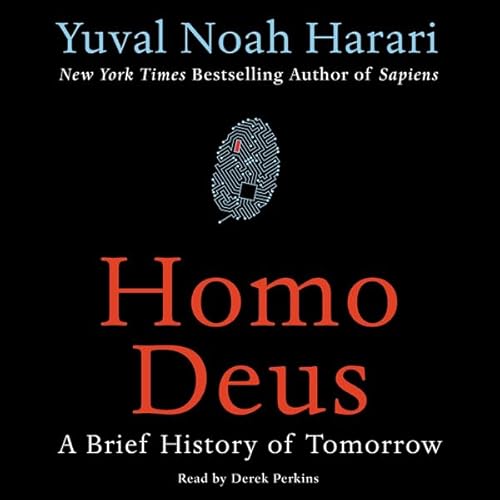
5. Homo Deus: A Brief History of Tomorrow by Yuval Noah Harari
The most natural follow-up to the sapiens book audiobook is Harari's own sequel. In Homo Deus, Harari shifts his focus from the past to the future, exploring the projects, dreams, and nightmares that will shape the coming centuries. He argues that humanity has largely solved the ancient problems of famine, plague, and war, and is now aiming for new goals: immortality, happiness, and divinity. The book examines the potential consequences of overcoming aging, engineering life, and creating artificial intelligence.
Derek Perkins returns as the narrator, providing a welcome sense of continuity. His familiar voice makes this transition from past to future feel like the next chapter in the same epic story. He handles Harari's speculative concepts with the same steady authority he brought to historical facts, making even the most futuristic ideas sound plausible and worthy of serious consideration. Listening to Homo Deus directly after Sapiens is a powerful experience, as you can see how the historical forces described in the first book are setting the stage for the technological and ethical dilemmas of the next. This is a must-listen for anyone who finished Sapiens and immediately asked, 'So what happens now?'
6. Why Nations Fail by Daron Acemoglu & James A. Robinson
This book offers another compelling framework for understanding global inequality, focusing on a different primary cause than either Sapiens or Guns, Germs, and Steel. Economists Daron Acemoglu and James Robinson argue that the critical factor is not geography or culture, but man-made political and economic institutions. They make a powerful case that 'inclusive' institutions, which protect property rights and encourage investment and innovation, lead to prosperity, while 'extractive' institutions, designed to funnel wealth to a small elite, lead to poverty and stagnation.
Narrator Stephen Graybill delivers this thesis with a confident, engaging cadence. He makes the economic and political theories accessible by giving voice to the numerous historical case studies the authors use, from the Roman Empire to modern-day Botswana. His performance helps distinguish between the theoretical framework and the historical examples that support it. For the listener who enjoyed the way Sapiens explained the rise and fall of empires, Why Nations Fail provides a sharp, focused economic lens to analyze those same patterns. It is an excellent choice for understanding the mechanics of power and prosperity in the modern world.
Exploring these titles can deepen the understanding gained from the sapiens book on tape. Each offers a piece of the puzzle, helping you build a more complete picture of our past, present, and future. Many listeners look for ways to listen to the sapiens audiobook free, and a great way to do that with any of these titles is by using a trial membership.
How Audible's Free Trial Works: Everything You Need to Know
Is Audible Worth It? An Honest Breakdown of the Membership